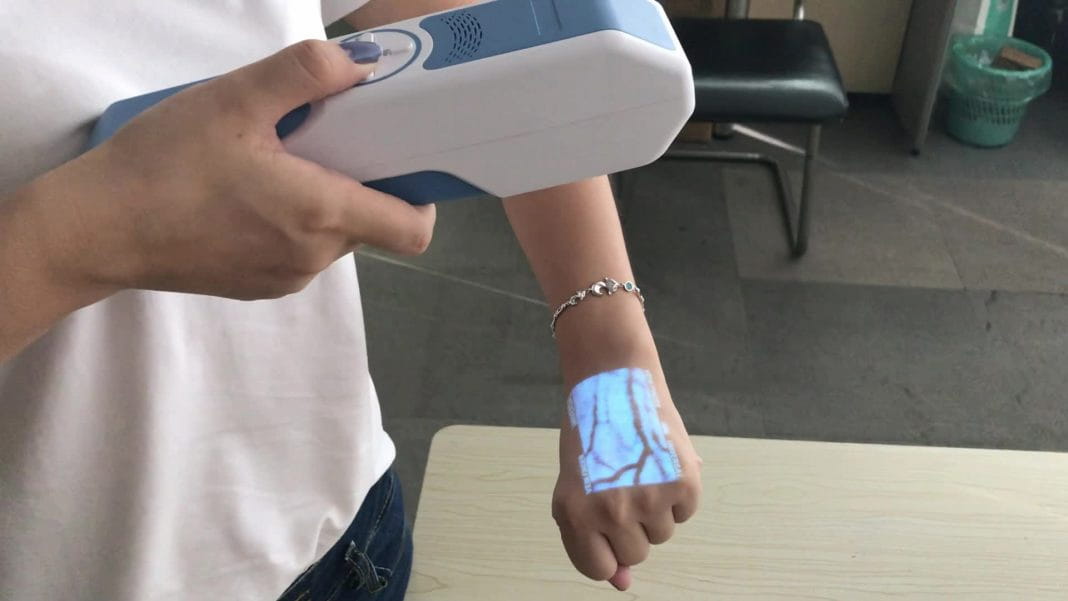
If you’ve ever had blood drawn, you know that one of the hardest parts is finding a vein. The nurses or phlebotomists will often poke around for a while before they finally hit the target. But what if there was a way to see veins beneath the surface of the skin?
That’s where vein finder displays come in. Vein finder displays use infrared light to locate veins beneath the surface of the skin. The light is absorbed by the blood in the veins, and this allows the vein to be seen on the display. While this technology is still new, it shows promise for making blood draws easier and less painful.
In addition, it may also have other applications, such as helping to locate veins for intravenous access in patients who are difficult to stick. So far, vein finder displays have been shown to be accurate in locating veins up to a depth of about 3 cm. Let’s get into the details of how vein finders work and how they display the veins beneath the surface.
How Does Vein Finder Work?
As we already mentioned, vein finders are the devices used to locate veins beneath the skin surface. Vein finders use a process called Near-Infrared (NIR) absorption to locate veins beneath the skin’s surface.
NIR light is passed through the skin and absorbed by the hemoglobin in the blood. This absorption creates heat, which is then detected by sensors in the vein finder. The sensor data is processed by algorithms that create a map of the veins, which is then displayed on a screen or on a patient’s skin.
Vein finders can be used to quickly and easily locate veins, making them an essential tool for both medical professionals and patients.
Which Veins are more likely to be located with Vein Finders
Veins that are close to the surface of the skin are more likely to be located with vein finders. This is because NIR light is absorbed more readily by veins that are close to the surface. In addition, larger veins are also more likely to be located with vein finders.
This is because larger veins have more blood, and thus more hemoglobin, which absorbs more NIR light. Apart from this, superficial veins that have high blood flow are also more likely to be located as the high blood flow results in more NIR light being absorbed.
How Can You Ensure the Accuracy of Vein Finder Display
There are a few things you can do to ensure the accuracy of your vein finder display.
· First, make sure that the device is properly calibrated.
· Second, keep the sensor clean and free of debris.
· Third, avoid using the device in direct sunlight or other sources of intense light.
· Finally, be sure to follow the manufacturer’s instructions for use. B
By taking these simple precautions, you can help to ensure that your vein finder provides accurate and reliable results.
The Benefits of Using Vein Finder
There are many benefits to using a vein finder.
· For one, it can help you locate veins that are difficult to find, making it easier to draw blood or insert IVs.
· It can also help you avoid collapsing veins, which can be painful and difficult to treat. Additionally, using a vein finder can help you choose the best sites for injecting medication and can reduce the risk of infection.
· Finally, vein finders can simply make your job easier by helping you quickly and easily locate veins.
Whether you’re a medical professional or simply someone who struggles to find their veins, a vein finder can be a valuable tool.
Where to get a Vein Finder for Yourself
If you’re looking for a Vein Finder, the best place to start is your local pharmacy. They usually have a small selection of Vein Finders to choose from, and the staff can help you find the right one for your needs.
If you’re looking for a more comprehensive selection, however, you’ll likely need to go online. There are a number of online retailers that sell Vein Finders, and they often have a much wider selection to choose from. Whichever route you decide to go, be sure to compare prices and read reviews before making your purchase.
With a little bit of research, you should be able to find the perfect Vein Finder for yourself in no time.
FAQs
Q: Are vein finders accurate?
A: Vein finders are typically quite accurate, but there are a few things you can do to ensure the accuracy of your device such as making sure it is properly calibrated, keeping the sensor clean, and avoiding using it in direct sunlight.
Q: Does the vein finder require any special expertise to use it?
A: No, vein finders are designed to be used by anyone, so you don’t necessarily have to be an expert to operate them. However, it is always a good idea to read the manufacturer’s instructions before using any new device.
Q: Can I use a vein finder on myself?
A: Yes, you can use a vein finder on yourself. However, it is always best to consult with a medical professional before using any new medical device.
Q: How often should I replace my vein finder?
A: There is no set answer to this question as it will depend on how often you use your device and how well you take care of it. However, it is generally a good idea to replace your vein finder every few years to ensure you have an up-to-date model.
The Bottom Line
So, what do you think? Will vein finders take over the medical market and become as commonplace as thermometers? Or will they fade into obscurity like so many other technologies that never quite caught on? Only time will tell.
In the meantime, we hope this article has given you a better understanding of vein finders – both their benefits and their limitations. We also hope it has inspired you to ask more questions about the technology and to keep an open mind about its potential uses.
Read Also
- Innovative Technologies in Oncology: The Future of Cancer Treatment
 Have you ever wondered how far cancer treatment has come in recent years? Advances in technology are making a real difference in the fight against cancer. Today, more people are living longer and healthier lives after a cancer diagnosis. This is all thanks to new and groundbreaking medical advancements. The future of cancer care looks… Read more: Innovative Technologies in Oncology: The Future of Cancer Treatment
 - Cloud-Based Healthcare Administration Solutions: A Guide for Payers, TPAs, and Provider NetworksHealthcare administration has become too complex for disconnected spreadsheets, aging on-premise applications, and manual handoffs between departments. Organizations need technology that can manage claims, enrollment, billing, provider relationships, and member data as connected parts of the same operation. MCSI – Visova is one example, offering a cloud-native vpaas designed to support HIPAA-compliant healthcare administration. Its… Read more: Cloud-Based Healthcare Administration Solutions: A Guide for Payers, TPAs, and Provider Networks
- How Intelligent Invoice Processing Is Reshaping Healthcare AP WorkflowsWhat happens when healthcare invoice volumes outpace the AP team’s ability to review, validate, and route them, while cost per invoice keeps rising? That gap is pushing finance leaders past basic digitization. Supplier invoices across formats, systems, departments, and approval paths, and holding speed, accuracy, compliance, and visibility together gets harder at scale. Intelligent invoice… Read more: How Intelligent Invoice Processing Is Reshaping Healthcare AP Workflows
- From 1905 to 2026: How German Legacy Manufacturers Power Deutsche Dental Technologien’s SuccessFrom 1905 to 2026: How Busch & Co.’s Legacy Powers Deutsche Dental Technologien’s Success In an era where dental technology advances at breakneck speed, few companies embody the perfect blend of historic craftsmanship and modern business agility quite like Busch & Co. and its strategic partner Deutsche Dental Technologien. What began as a small dental bur factory in… Read more: From 1905 to 2026: How German Legacy Manufacturers Power Deutsche Dental Technologien’s Success
- Why the Future of Healthcare Administration is Cloud-NativeThe operational demands placed on modern healthcare administrators have officially outpaced the capabilities of traditional IT infrastructure. While clinical medicine continues to advance at breakneck speed, the back-office systems required to support it often remain painfully stagnant. Today’s insurers, Third-Party Administrators (TPAs), and provider networks are forced to navigate an avalanche of daily claims, aggressive… Read more: Why the Future of Healthcare Administration is Cloud-Native